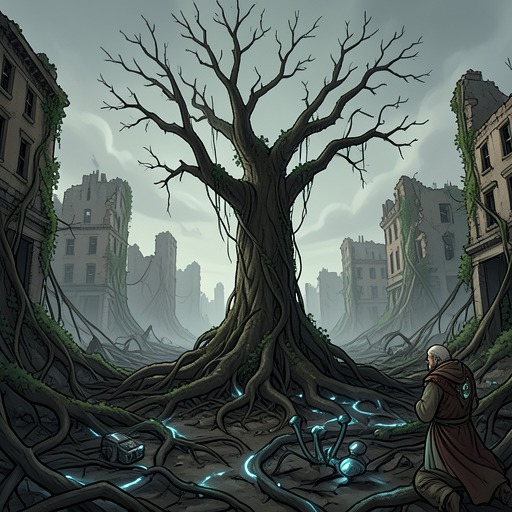
Death Assault of the Deserted City
Chasing SunlightDeath Assault of the Deserted City begins when Jonathan Heights kills an agent of the Exploration Society inside the abandoned city, and the violence summons something far more dangerous than an ordinary retaliation. The event is not simply an attack by a creature or army: it is the city’s awakening as a force of death-consciousness, one that invades thought, reshapes space, and makes every member of the expedition confront the desire to die. Its decisive significance lies in the way it tests Jonathan Heights’s newly acquired sunlight against a hunger that can reach flesh, stone, memory, and even the self’s most guarded convictions.
The Killing That Awakens the City
Jonathan Heights enters the confrontation already carrying the accumulated grievance of his previous expeditions and his hostility toward the Exploration Society. When Robert, an agent of that organization, crosses his path, Jonathan Heights remembers his promise to destroy the next such agent he encounters. He seizes Robert by the throat and allows the fury he has been suppressing to take hold. Robert’s eyes burn out under the intensity of Jonathan Heights’s sunlit soul; the agent then collapses, scorched and smoking, before Jonathan Heights releases the body.
The killing immediately alters the expedition’s internal balance. Antomine protests with rage, addressing Jonathan Heights’s act as an intolerable violation of authority and conduct, but his rebuke is interrupted when the presence behind the city’s doors and windows comes howling inward after Robert’s corpse. The sequence therefore joins personal vengeance to supernatural consequence: Jonathan Heights’s decision does not remain a contained execution. It becomes the immediate occasion for the deserted city to reveal its appetite, turning a conflict with the Exploration Society into a collective struggle for survival.
The City as an Incarnation of Dying
The force awakened by Robert’s death has no visible or audible body. It is neither a ghostly creature nor a conventional supernatural attacker, but a raw concentration of lonely longing, nostalgia, and desire for the instant in which life passes into death. Its domain is the infinitesimal interval poised between existence and oblivion: not death itself, and not life, but the seductive final moment before the abyss closes. The presence imposes this sensation directly upon its victims, hammering memories and images of dying into their minds until the expedition staggers beneath emotions that do not originate in ordinary fear. Death becomes not merely an outcome to avoid but an exquisite experience the city urges them to seek.
The Assault on Mind and Body
The city’s death-impulse reaches even Jonathan Heights, despite the sunlight filling him. Under its pressure, he grips his cane until his knuckles whiten and feels an urgent temptation to turn the weapon against his own throat or smash his head against the stone. The force does not distinguish among bodies, buildings, or insubstantial dreams: its ideation of dying finds purchase in anything capable of being affected. Eleanor resists while clutching her dagger, but Sarah and Marie faint; Antomine alone straightens with purposeful control, his eyes glowing as he orders his guards to disarm Eleanor and carry the unconscious women. Jonathan Heights survives the first assault not by destroying the presence, but by separating its intrusive commands from his own intentions and reducing them to an insistent murmur at the edge of consciousness.
The Device That Blunts the Assault
The saboteur’s death intensifies the city’s appetite, but the expedition still has a practical objective: recovering the stolen mechanism containing the luminiferous gems taken from the Endeavor. Jonathan Heights hooks the sled toward himself, opens its bag despite the mental pressure, and seizes the broken glass-and-steel assembly. Antomine immediately claims it, and Jonathan Heights yields it because the inquisitor is not the enemy. When Antomine makes the gems flare and his own eyes shine with comparable brilliance, the suicidal compulsion recedes from an overwhelming command to a background scratch of contemplation. The assault is not defeated, but its intensity becomes resistible, revealing that concentrated illumination can interrupt the city’s influence without destroying the force producing it. The Lux Guards are unaffected from the beginning; Jonathan Heights suspects that the Illuminated King has altered them so thoroughly that even their lives are no longer theirs to spend.
Escape Through Rewritten Streets
The reduced pressure gives the expedition only a temporary advantage. Jonathan Heights finds the room physically unchanged, yet the deserted city has begun to alter the route itself. Antomine takes the lead, while Jonathan Heights remains close enough to correct his direction, and the group moves through streets whose ordinary sounds are translated by the city into imagined acts of self-destruction: boots become the scrape of a drawn blade, a dagger’s movement, or the click of a zint-pistol being readied. Familiar intersections fail to appear where Jonathan Heights expects them, and each successive turn adds sharper corners, more treacherous street edges, and objects that seem prepared to break bones or open veins. A curb even cuts his cheek when he turns too quickly, proving that the city’s murderous suggestions can acquire physical consequences. Jonathan Heights refuses to follow its implied rules and offers Antomine his pistol, allowing the inquisitor to extract the luminiferous gems and fire a zint beam straight through walls and lampposts. The shot punches a visible corridor through the altered architecture, creating a path toward the ship. Eleanor runs first, followed by the guards carrying Sarah and Marie, while Jonathan Heights brings up the rear behind Antomine. When Antomine falters, Jonathan Heights lifts him and continues carrying him; Eleanor, meanwhile, manages to vault through the openings without yielding to the compulsion to stop and bleed. After roughly a minute of full-speed running, the group reaches the Endeavor, though the ship appears momentarily unfamiliar against the death-drunk city. They seize the tether and climb aboard with torn clothing and unsteady bodies, while Eleanor revives Sarah and Marie and Antomine retains the device and gems. Once the city disappears from sight, the ideation of dying vanishes as abruptly as it arrived, leaving the expedition alive but aware that escape, rather than victory, was the only achievement.
The Event’s Wider Significance
Death Assault of the Deserted City is a threshold episode in which violence, illumination, and mortality become inseparable. Jonathan Heights’s execution of the Exploration Society agent is both a private act of retribution and the trigger for a force that exposes the limits of his sunlight. The event demonstrates that illumination does not make him invulnerable: it gives him the discipline to recognize the city’s suicidal suggestions as alien, but it does not prevent those suggestions from entering his mind. Antomine’s intervention provides the practical countermeasure, as the luminiferous gems reduce the assault without abolishing it, while the Lux Guards’ immunity hints at the more disturbing cost of service to the Illuminated King. The expedition therefore survives through cooperation among incompatible forms of power—Jonathan Heights’s self-command, Antomine’s consecrated light, the guards’ altered nature, and Eleanor’s physical resolve—rather than through any single character’s mastery.
The episode also establishes a recurring pattern in the wider journey: the eastern world is not merely populated by hostile beings but governed by conditions that rewrite perception, identity, and the meaning of survival. The city’s streets become dangerous because thought and architecture converge; its attack is psychological, yet a curb cuts Jonathan Heights’s cheek and the altered route must be breached by force. This unstable boundary between idea and matter anticipates later encounters with temporal distortion, divine dreams, the Players, and Bright Defile’s demand that every attachment be sacrificed. Jonathan Heights’s escape is consequently not a conquest of the city’s death-consciousness. It is a temporary refusal to accept the terms it imposes, achieved by carrying the damaged device and its gems back to the Endeavor while the city remains physically intact and spiritually unexplained.
The Assault on Mind and Body
The city’s death-impulse reaches even Jonathan Heights, despite the sunlight filling him. Under its pressure, he grips his cane until his knuckles whiten and feels an urgent temptation to turn the weapon against his own throat or smash his head against the stone. The force does not distinguish among bodies, buildings, or insubstantial dreams: its ideation of dying finds purchase in anything capable of being affected. Eleanor resists while clutching her dagger, but Sarah and Marie faint; Antomine alone straightens with purposeful control, his eyes glowing as he orders his guards to disarm Eleanor and carry the unconscious women. Jonathan Heights survives the first assault not by destroying the presence, but by separating its intrusive commands from his own intentions and reducing them to an insistent murmur at the edge of consciousness.
The death-impulse reaches even Jonathan Heights, despite the sunlight filling him. Under its pressure, he grips his cane until his knuckles whiten and feels an urgent temptation to turn the weapon against his own throat or smash his head against the stone. The force does not distinguish among bodies, buildings, or insubstantial dreams: its ideation of dying finds purchase in anything capable of being affected. Eleanor resists while clutching her dagger, but Sarah and Marie faint; Antomine alone straightens with purposeful control, his eyes glowing as he orders his guards to disarm Eleanor and carry the unconscious women. Jonathan Heights survives the first assault not by destroying the presence, but by separating its intrusive commands from his own intentions and reducing them to an insistent murmur at the edge of consciousness.
The Assault on Mind and Body
The city’s death-impulse reaches even Jonathan Heights, despite the sunlight filling him. Under its pressure, he grips his cane until his knuckles whiten and feels an urgent temptation to turn the weapon against his own throat or smash his head against the stone. The force does not distinguish among bodies, buildings, or insubstantial dreams: its ideation of dying finds purchase in anything capable of being affected. Eleanor resists while clutching her dagger, but Sarah and Marie faint; Antomine alone straightens with purposeful control, his eyes glowing as he orders his guards to disarm Eleanor and carry the unconscious women. Jonathan Heights survives the first assault not by destroying the presence, but by separating its intrusive commands from his own intentions and reducing them to an insistent murmur at the edge of consciousness.
The Assault on Mind and Body
The city’s death-impulse reaches every member of the expedition according to a different vulnerability, making the assault a collective ordeal rather than a uniform attack. Jonathan Heights, although sunlight fills him, feels the temptation to turn his cane against his throat or dash his head against the stone; the force can take hold of flesh, stone, and even insubstantial dreams because it is not merely a weapon but an ideation of dying. Eleanor clutches her dagger while struggling to remain herself, whereas Sarah and Marie lose consciousness under the pressure. Antomine resists more decisively: his eyes glow as he orders one Lux Guard to seize Eleanor and remove her dagger, while the other assists the maids. Jonathan Heights finally regains control by recognizing the suicidal commands as foreign intrusions rather than authentic desires, reducing them to an insistent murmur that he can endure without mistaking it for his own will.
The Force Behind the City
The force awakened by Robert’s death is not a creature with a body, voice, or ordinary location. It is a concentration of lonely longing and nostalgia for the instant of dying: neither death itself nor life, but the final interval poised between them. Its attack reaches the expedition as intrusive memories and images, transforming mortality from an external danger into a seductive experience. The presence does not merely threaten to kill its victims; it presses them toward the exquisite moment of surrender, making the desire for death feel intimate, persuasive, and almost tender.